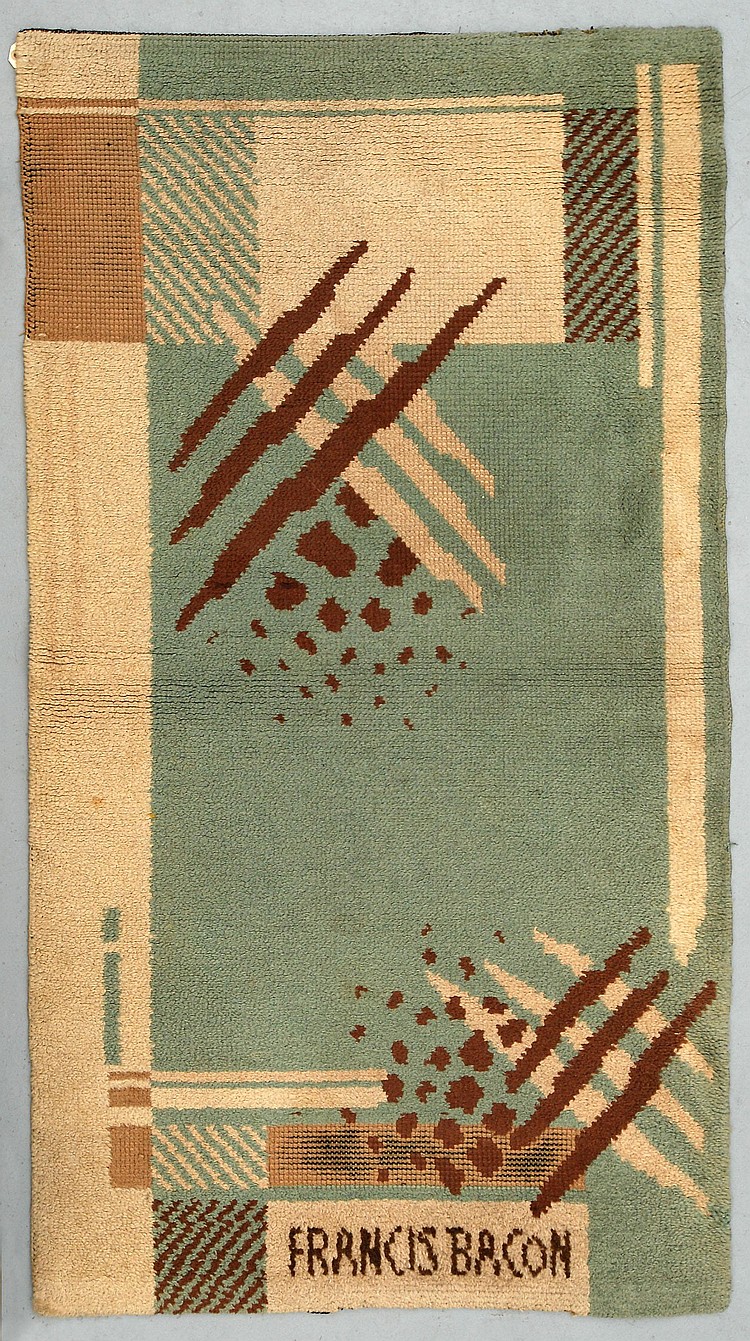
Hand-knotted rug with abstract design, Wilton
Hand-knotted rug with abstract design, Wilton Carpet Factory, England, about 1929, signed at the base 'FRANCIS BACON', 5ft.5in. x 3ft. 1.65m. x 0.91m. Uneven corrosion of the light tan brown. REF. DEP. Francis Bacon's early career as a designer of furniture, carpets, textiles and other domestic furnishings remains largely unresearched and very little has been published.The story of Bacon being evicted from the family home in Ireland in 1926 after his father had caught him posing in front of a large mirror wearing items of his mother's underwear, is fairly well-known.This scene, like something out of a blackly comic Joe Orton play, had the effect of causing Bacon to settle permanently in London from 1928 onwards.Without wishing to belabour the point, it is perhaps worth noting here that the ground colour of the two rugs offered is that distinct pastel green called eau-de-nil that Bacon seems to have returned to frequently throughout his career as a painter; it is also one of the colours most used in the early years of the 20th century by fashion designers and in particular by designers of female undergarments. Bacon established himself as an interior decorator and designer of domestic furnishings at 17 Queensberry Mews, South Kensington, and he held the first show of his paintings, rugs and furniture at this address at some time in late 1929. According to Richard Shone, in his article 'Francis Bacon in 1930: an early exhibition rediscovered' (The Burlington Magazine Vol. 138, no. 1117, April 1996, pp. 253-55), virtually nothing is known of this first exhibition; all the paintings were subsequently destroyed and there is no documentary evidence to connect any known surviving work in any other medium with it.The second show, however, which was also held at Queensberry Mews in November 1930, and which was held jointly with the Australian painter Roy de Maistre and the English actress and talented portraitist Jean Shepeard, is better documented.There is a very small number of surviving rugs which share a late Cubist style influenced not only by the paintings of Le Maistre but more directly by Le Corbusier's painting style and by the French artist and tapestry design Jean Lurçat. Definite connections can be made between the very small number of surviving rugs in this style, which include an example in the Victoria and Albert Museum, in a collection in Turin and in the Felix Marcihac collection, Paris, and the two rugs offered here.The Marcihac rug is illustrated by Susan Day in Art Deco and Modernist Carpets, fig.215 and it can be seen that among the stylistic connections between that rug and the present two is the blocking of colours at the sides so as to form an understated border and, perhaps most significantly, the large inwoven signature at the lower end. Structurally and in size, all the extant Bacon rugs are very similar; the present two, with their sewn-under flat-weave strips at both ends, their symmetric knotting, wool warps and probably jute wefts, are typical of hand-knotted Wilton rugs in the inter-War years. Unfortunately, although Bacon is known to have had his rugs woven at Wilton, all the records of that factory were destroyed when it changed hands some years ago. Given the difference in style between the present rugs and the very small number extant from the 1930 show (examples of Bacon's work in furniture and rug design can be seen in three photographs accompanying the article 'The 1930 Look in British Decoration', The Studio, 100, no. 449, August 1930, pp. 40-1) it is arguable that these two matching pieces were either made for the earlier show in 1929 or for a subsequent special commission. The two rugs have been submitted to the Authentication Committee of Francis Bacon:The Catalogue Raisonné for their opinion and in a letter dated 25 January, 2009, Dr. Rebecca Daniels,Art Historical Researcher to the Committee, writes:'Research into Bacon's early career as an interior designer is in its early stages...Based on current available knowledge it appears that the rug and runner are consistent in style, manufacture and signature with the small output of rugs that Bacon designed and had made up at Wilton in c. 1929.The condition of the rug is also consistent with a date around c.1929.The design of the rug and the ground colour are, to date, unique...' Needless to say, Bacon's known rugs are exceptionally rare and to our knowledge no example has changed hands in recent years.These remarkable discoveries add yet another link in the earliest art historical narrative of one of the 20th century's greatest artists. Netherhampton Salerooms would like to thank Dr Rebecca Daniels and her colleagues at the Authentication Committee of Francis Bacon: The Catalogue Raisonné for their assistance in the preparation of this catalogue note.
- The cost is converted to USD at the rate of 1 GBP = 1.387175 USD on 2009-03-12.
-
Sign in to view
Lot number
-
Sign in to view
Estimate
-
2009-03-12
Sale date
-
Sign in to view
Realised price
-
Sign in to view
Opening price
-
Sign in to view
House name
-
Sign in to view
Auction sale name
-
Sign in to view
Location
-
Categories
Sign in to view -
Tags
Sign in to view