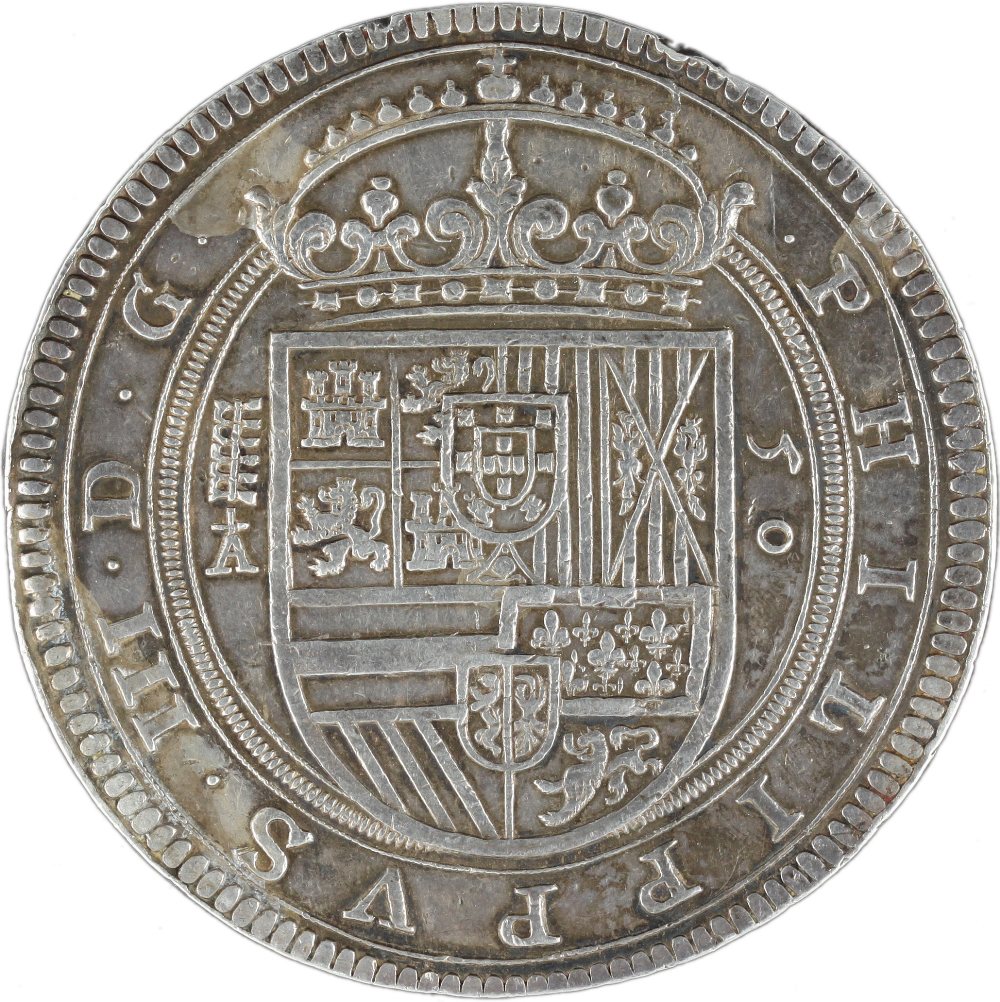
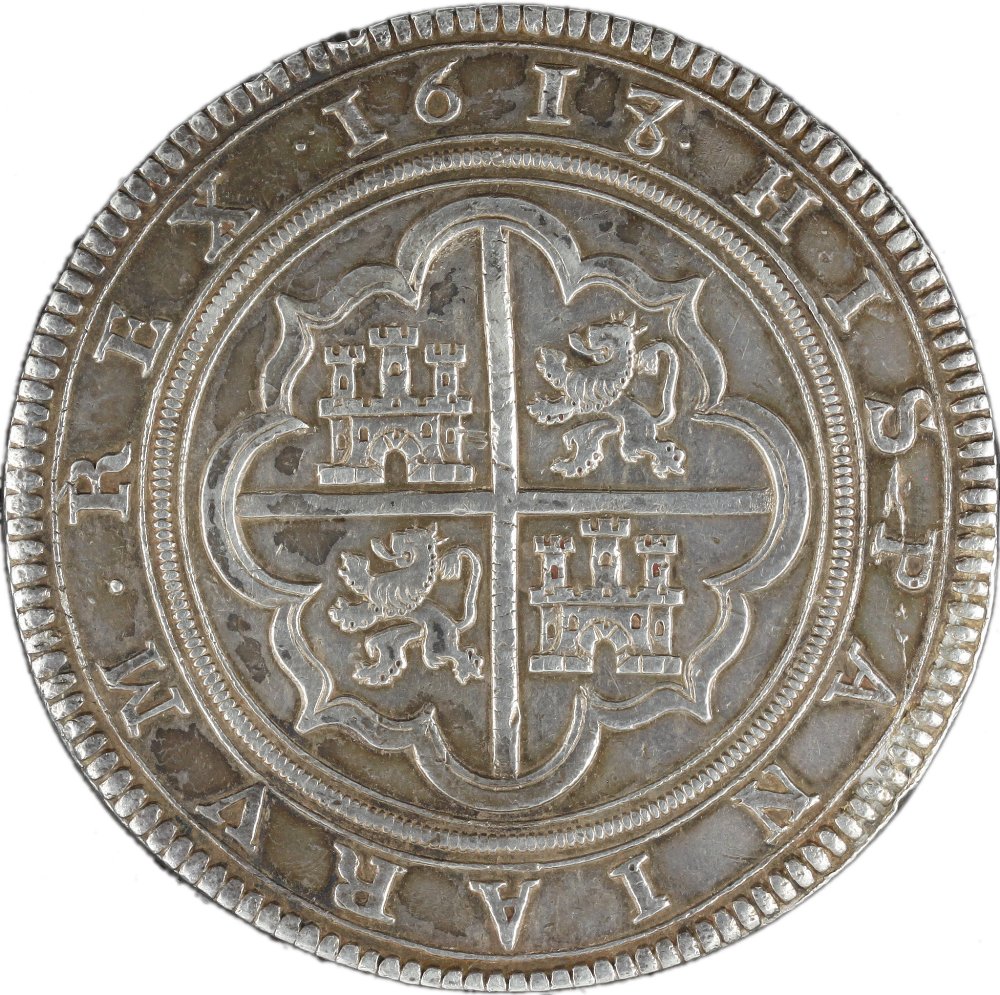
Spain, Philip III, 50 reales (cincuentine), 1618/17, Segovia mint, Assayer A with cross (Esteban
Spain, Philip III, 50 reales (cincuentine), 1618/17, Segovia mint, Assayer A with cross (Esteban de Pedrera), crowned Spanish shield of arms, rev. arms of Castile and Leon (KM.65; Calico 80, same dies), a few minor edge bruises, to be expected from a coin of this size and mass, otherwise about extremely fine, a highly attractive piece with old cabinet tone, very rare The first shipment of silver from Seville arrived in Segovia via mule train on January 2nd 1618, and the minting of new coinage proceeded shortly thereafter. It is believed that the Cincuentines were produced sometime during the first months of that year, and that all coinage was completed by July 8th. According to official accounts only 20 examples of Cincuentines were authorized to be produced in 1618. During the time of their production the chief die engraver was away visiting Madrid and new dies had not yet been produced. To remedy the situation dies from 1617 were reused, having the final digit of the date reworked. Only one set of dies is known for the 1618 Cincuentines, the obverse later being used to produce the 1620 issue. Of the 20 examples that were authorized, fewer than half are known to exist today. Our research has been able to confirm the existence of only 8 examples of the original 20 minted. One such example is housed in the British Museum, acquired in 1847, and can be viewed on their website in the Explore/Highlights section (ref. CM 1847-2-16-23). Cincuentines have been highly coveted and sought after by collectors since the time of their inception in the 17th century. These massive silver coins were produced in extremely small quantities, under specific circumstances for a special purpose. As a monetary unit the 50 Reales seems a bit out of place in the monetary system that the Spanish used in the 17th century, where each subsequent denomination was divisible. It was a rather odd denomination that would take six 8 Reales and a 2 Real to make exact change, not to mention it was totally impractical for day to day transactions due to its high intrinsic value. Some have argued that 50 reales were used as a store of wealth in a similar manner to some multiple thalers used in other parts of Europe. Although this seems plausible, with an abundance of gold flowing in from the Spanish colonies of the New World, it would be much easier to store large sums of wealth in gold. Furthermore, Cincuentines were never produced on a large enough scale to make them viable as a store of wealth in that manner. In contemporary times very few people would have ever seen a 50 Reales unless they were part of Spanish Royalty or the social elite. Their purpose was more along the lines of specially made presentation pieces or gifts during special events for people of great importance. The coin offered here is a real numismatic prize that remains as highly coveted by modern day collectors as it would have been by its recipient at the time of issue.
- The cost is converted to USD at the rate of 1 GBP = 1.55225 USD on 2015-09-21.
-
Sign in to view
Lot number
-
Sign in to view
Estimate
-
2015-09-21
Sale date
-
Sign in to view
Realised price
-
Sign in to view
Opening price
-
Sign in to view
House name
-
Sign in to view
Auction sale name
-
Sign in to view
Location
-
Categories
Sign in to view -
Tags
Sign in to view