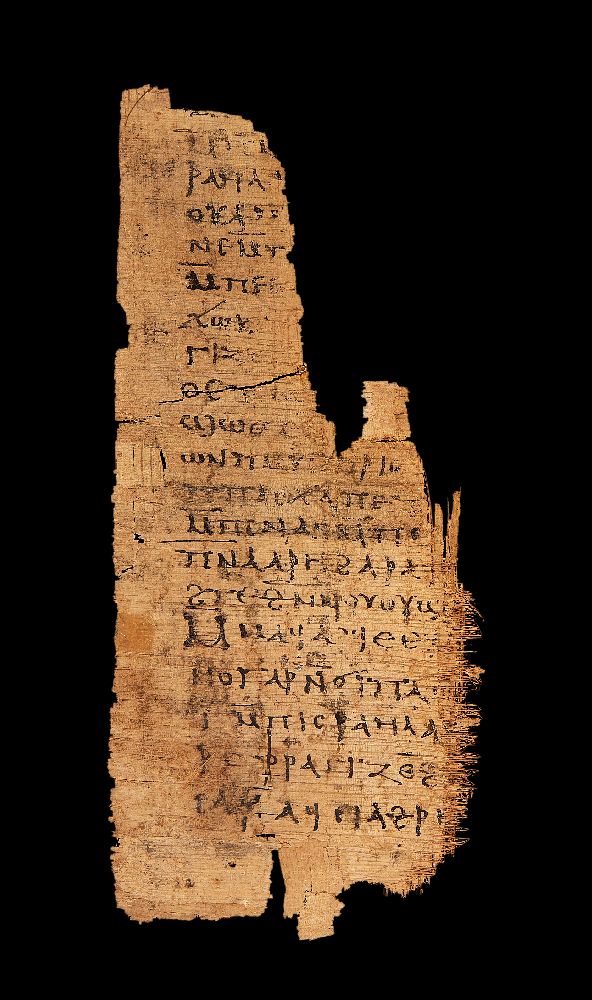
ǂ The Bruce fragment of Melito of Sardis, Peri Pascha
ǂThe Bruce fragment of Melito of Sardis, Peri Pascha (homily on the Paschal mystery, quoting Exodus 12:5-11), in Akhmimic dialect of Coptic, manuscript on papyrus [Upper Egypt, fourth century] Fragment of a single sheet, with remains of up to 19 lines from a single column (140 by 50mm.) in Coptic half-uncials (with chs. 10-13 and 15-17 of the text), largest losses from upper righthand corner, some scuffs and stains, but overall in good and legible condition, overall 170 by 70mm.; set in glass on both sides and in fitted blue case Provenance:1. Most probably written for a Coptic monastic community in Upper Egypt, perhaps inWadi Natrun or Dishna.2. Acquired in Amsterdam in early 1970s by Dawson’s Book Shop, Los Angeles (c. 1970), perhaps from the residue of the collection of the Dutch dealer Eric von Scherling (1907-1956), and if so acquired by him while in Egypt in the 1930s.4. Robert X. Bruce, Newport Beach/Balboa, California, and from him to Bruce Ferrini (1950-2010).4. The Schøyen Collection, Oslo and London, their MS. 2337, acquired from Ferrini in 1996. Text:Melito of Sardis was the bishop of Sardis (near Smyrna/Izmir, modern Turkey) until his death c. 180 AD., and was perhaps the foremost titan of biblical scholarship in the second century AD. Jerome commends his Old Testament canon, and repeats Tertullian’s assertion that many thought him a prophet because of it. Due perhaps to the great antiquity of his works and the fact that they were written and dispersed during the period in which Christianity was an illegal sect, few survive, and until the discovery of a fragmentary Greek papyrus in 1940 this text was only known from a reference to it in the fourth century by Eusebius (see C. Bonner, The Homily on the Passover by Melito Bishop of Sardis, 1940). The subsequent decades saw a growing scholarly interest in it and a handful of other witnesses have come to light. No complete manuscript of the text is known, and it must be reconstructed from nine extant fragments in Greek, Coptic, Syriac, Georgian and a Latin epitome. This fragment is the only one in the ancient Coptic dialect of Akhmimic (which flourished only in the fourth and fifth centuries in the region around Akhmim/Panopolis), and was copied a little over a century after the composition of the text. None has ever appeared before on the open market. The text was probably pronounced during Easter, and revealed the meaning of Christ’s Paschal mystery. It has been argued by some that it provides evidence of an exceptionally rare point of direct contact between the rites of the Jews and early Christians, in that it seems to be based on the Jewish Haggadah of Pesach, and Melito himself appears to be trying to equate the two traditions. An English translation by S.G. Hall, Melito of Sardis, On Pasha and Fragments, appeared in 1979. Published:J.E. Goehring, ‘A New Coptic Fragment of Melito’s Homily on the Passion’, Le Museon 97 (1984), pp. 255-60 (in this the present manuscript is given the siglum ‘Br’ for Bruce).W.P. Funk, ‘Die Zeugen der Koptischen Literaturdialekts 17’, Zeitschrift für ägyptische Sprache und Altertumskunde, 114 (1987), pp. 117-33.J.E. Goehring and W.H. Willis, ‘Melito of Sardis on the Passover’, in Goehring, ed., The Crosby-Schøyen Codex, 1990, p. 3.D. Powell, Guide to Christian Apologetics, 2006, p. 157 (illustrated) ǂ Lots marked with a double dagger (ǂ) (presently a reduced rate of 5%) have been imported from outside the European Union to be sold at auction and therefore the buyer must pay the import VAT at the appropriate rate on the hammer price.
- The cost is converted to USD at the rate of 1 GBP = 1.32655 USD on 2018-07-10.
-
Sign in to view
Lot number
-
Sign in to view
Estimate
-
2018-07-10
Sale date
-
Sign in to view
Realised price
-
Sign in to view
Opening price
-
Sign in to view
House name
-
Sign in to view
Auction sale name
-
Sign in to view
Location
-
Categories
Sign in to view -
Tags
Sign in to view