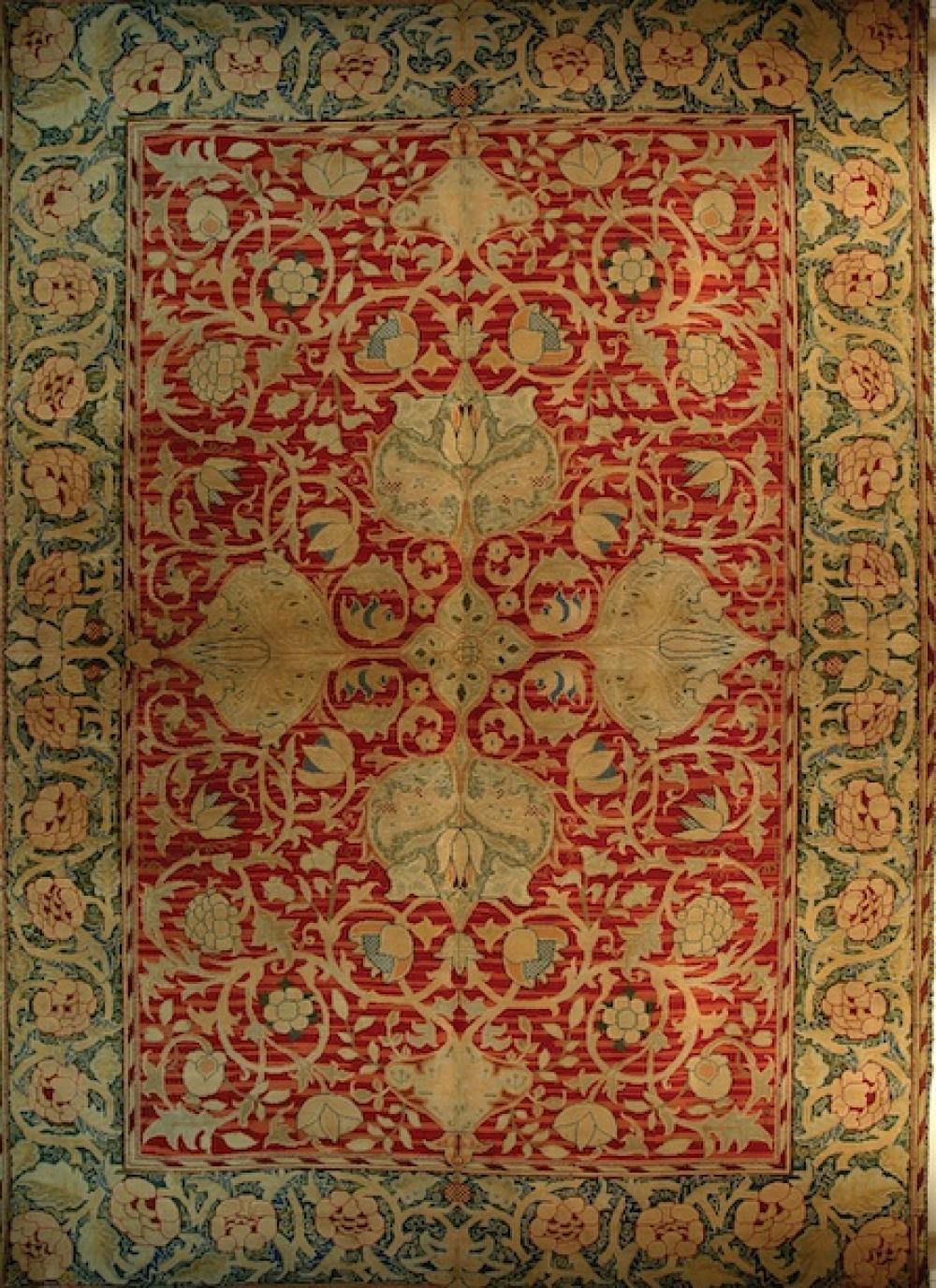
A fine William Morris Hammersmith carpet, after a design by William Morris and John Dearle, Merton Abbey Works, English, Circa 1889 530 x 353cm
A fine William Morris Hammersmith carpet, after a design by William Morris and John Dearle, Merton Abbey Works,
English, Circa 1889
enclosing stylised tulips extending into the field. A stylised vine and flower meander fills the the main sea-green border.
This striking carpet, designed by William Morris and his chief assistant, John Henry Dearle, was one of three new designs for "Bullers Wood House" in Chislehurst, Kent. The interior decoration of "Bullers Wood" in 1889 was one of Morris & Co.'s most important commissions and probably the last decorative scheme that Morris supervised himself. The four large palmettes radiating from the central medallion derive from the 16th and 17th-century Mughal Indian and Safavid Persian carpets that Morris collected for himself and for the newly-formed South Kensington Museum, the forerunner of the Victoria & Albert Museum. These motifs combined with floral devices unmistakably of his own design, produce a carpet of great beauty, harmony and balance. Testimony to the success of this design was the fact that it was used again for another very important commission, the decoration of Stanmore Hall, Middlesex, between 1890 and 1896. One of the other carpets commissioned for "Bullers Wood" is held in the collection of the Victoria and Albert Museum (exhibit T.31 – 1923) and is regarded as the most accomplished and famous of Morris's carpet designs.
Bullers Wood House was purchased by (Sir) John Sanderson in 1879, on his return to England after some successful years trading in the wool industry in Australia. It was a typically mid-Victorian house ideally situated for commuting to London and Sanderson decided to modernise and rebuild it to house his large family. The young architect Ernest Newton was employed for the exterior together with Morris & Co. for the interior. Newton had previously worked for Norman Shaw, a co-designer with Phillip Webb of Morris's "The Red House" in Bexeley.
The carpet remained in the house until 1921, when the house was sold. Some of the house contents were auctioned. This carpet with selected contents were kept by the family and installed in their West Australian residence, Lesmurdie House. It has passed by descent to the present owner.
Provenance:
Mr John Sanderson, commissioned in 1889, Bullerswood House, Chislehurst, Kent
Mr Archibald Sanderson, Lesmurdie House, Western Australia, by descent from the above
Private Collection, Perth, by descent from the above
Literature:
Pamela Todd, William Morris and The Arts and Crafts Home, San Francisco, 2005, p. 50
Pat Kirkham, 'The Firm: Morris & Company', in Diane Waggoner (ed.), The Beauty of Life, William Morris & the Art of Design, (ex. cat.), New York, 2003, p. 54.
Linda Parry, William Morris, Phillip Wilson Publishers in association with the Victoria and Albert Museum, London, 1996, p. 283
Ian Zaczek, William Morris, Paragon Books, London, 2001, p. 112
'Bullerswood Brought Home – A Dream Come True', Cloudband Magazine, September 2001, pp. 2-4
John Henry Dearle and Morris & Co:
In 1889 William Morris (1834 - 1896), reputedly, created his final carpet design for his firm Morris & Co. The following year John Henry Dearle (1860 - 1932) succeeded as principal designer for all carpets manufactured in Hammersmith and Merton Abbey. Dearle was designer of embroideries with May Morris from 1885 and had also been William's design assistant, however by his appointment in 1890 he had clearly developed his own style. He recognised the importance of maintaining the link between the company's founder and its future success, the same had been true in the previous years when May had undertaken the management and design of the embroideries. Yet Dearle was progressive and prepared the company for the shift in the market at the turn of the century; in which the Morris-led Arts and Crafts approach was being overshadowed by the desire for the exotic.
In keeping with Morris's ideals Dearle's designs incorporated many of the original, quintessentially British, flora and fauna motifs. He combined the importance of finesse in textile draftsmanship and an understanding, no doubt under Morris's influence, of the Persian designs of the 16th and 17th centuries, in particular the ‘vase' design from the Safavid era. These two disciplines allowed more extravagant and complicated patterns which prepared the company for the oncoming 20th century market. This can certainly be seen in the present lot when compared to the William Morris designed carpet made for the Wyndham family in circa 1887. However a certain stylistic symmetry is maintained, perhaps due to his training with embroideries and working with the talented May.
Morris's impact on Dearle is clearly visible when considering the Wyndham's ‘Clouds' carpet with the present lot. Although smaller in size the ‘Hammersmith' adopts the Morris school of design which can be seen through the use of the chequered tulips, scrolling acanthus, stylised roses, open palmette bulbs and scrolling vine motifs and the use of colour. It is the extravagance in the overall design which makes the present lot stand out as a work of Dearle's and marks an important change in the trajectory for designs produced by the company.
COMPARABLE EXAMPLES
A Hammersmith carpet commissioned by Australian Robert Barr Smith from Morris & Co, circa 1895, which was a variant of the similar design and colouring of an indigo ground and russet border, with a vine leaf scroll without the fruit, see The Eclectic Eye: Five Centuries of Art from the Galerie Yves Mikaeloff, Christie's, New York, 21st May 1997, lot 428 (previously sold at Sotheby's, Melbourne, 21st May 1996, lot 122).
The Best of British: Design from the 19th and 20th centuries (A Sotheby's event in collaboration with the specialist dealer Paul Reeves), Auction, Sotheby's, London, 20 March 2008, lot 96, for a Hammersmith Carpet, William Morris (1834 – 1896) and John Dearle (1860 – 1932), late 1880's, (approximately 390 by 282cm; 12ft. 9in., 9ft. 3in.). The chequered flowers and barbed floral motifs, present in this cited comparable and the present example were motifs identified by Linda Parry as being typical of Dearle and hence indicating his likely collaboration in the design.
Sotheby's, New York, 1 June 2006, lot 191, in which the example is to the design of John Henry Dearle and of very similar dimensions; approximately 630 by 381cm; 20ft. 8in, 12ft. 6in. This carpet also adopts the classic Dearle repeat ascending design and has a very similar border with stylised oak and birch leaves.
For further discussion of John Henry Dearle and William Morris carpets, see the following publications:
Haslam, Malcolm, Arts and Crafts Carpets, David Black, London, 1991, Chp.2. The Master, pp.38-85, for discussion of Morris and Hammersmith, and pp.80-84., for reference to John Henry Dearle (1860-1932), and his involvement and influence on designs, also Dearle's designs for Auchendarroch.
Parry, Linda, William Morris Textiles, London, 1983, for discussion on May Morris, John Henry Dearle as assistant and earl transactions from the patrons pp. 29 – 35. For comprehensive discussion and attributions of Morris Carpets and for details regarding the patrons, pp.96, 97 &145.
Great Carpets of the World, Ed. Alcouffe, Daniel, Chp. IX, The Carpet in Great Britain, Clothilde Galea-Blanc, pp.277-311, for discussion of William Morris, his associates and the English Arts and Crafts movement, pp.299-303.
Sherrill, Sarah, Carpets and Rugs of Europe and America, New York, 1996, Chp.8. Progressive Design, Mid-19th Century to Present, pp. 291-395, for discussion on William Morris, John Henry Dearle, the Morris & Co firm and the legacy. pp. 293-297 and pp. 304, 315, 317, 341 & 350.
- The cost is converted to USD at the rate of 1 AUD = 0.64485 USD on 2023-09-19.
-
Sign in to view
Lot number
-
Sign in to view
Estimate
-
2023-09-19
Sale date
-
Sign in to view
Realised price
-
Sign in to view
Opening price
-
Sign in to view
House name
-
Sign in to view
Auction sale name
-
Sign in to view
Location
-
Categories
Sign in to view -
Tags
Sign in to view