w - EDWARD MCKNIGHT KAUFFER, WOVEN BY WILTON ROYAL CARPET MANUFACTURING COMPANY LTD. AN
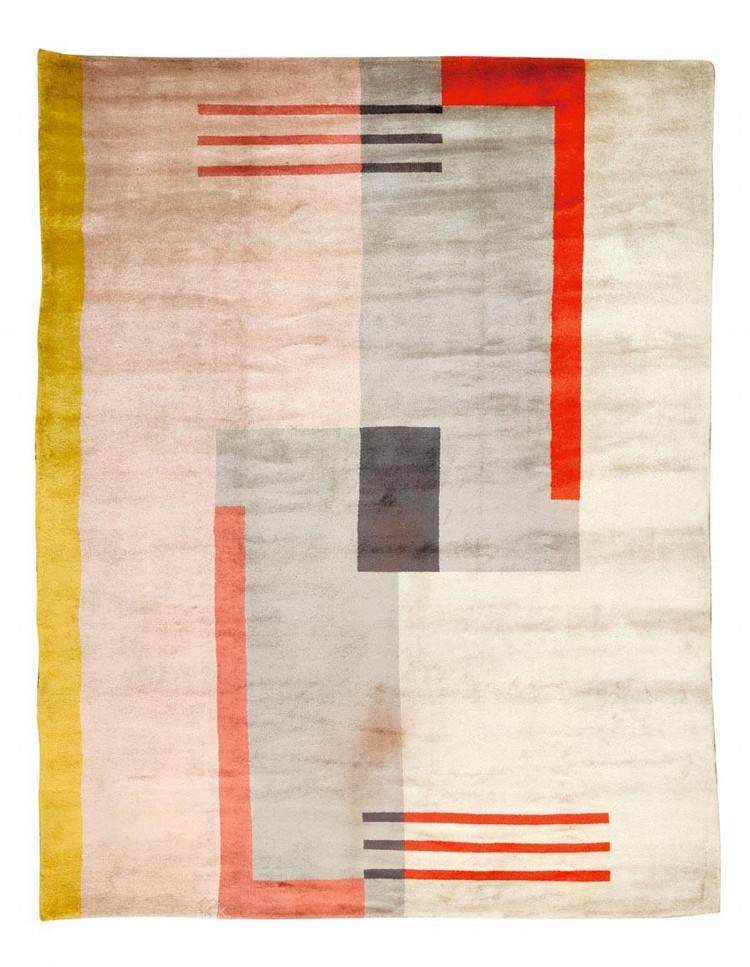
w - EDWARD MCKNIGHT KAUFFER, WOVEN BY WILTON ROYAL CARPET MANUFACTURING COMPANY LTD. AN IMPORTANT 'WESSEX' HAND-TUFTED MODERNIST CARPET
circa 1930
wool pile
with woven designer's monogram
EXHIBITED
Jacqueline Pruskin, British Carpets and Designs: The Modernist Rug 1928 - 1938, exhibition catalogue, Royal Pavilion, Art Gallery and Museums, Brighton, 1975, cat. no. 1.
LITERATURE AND REFERENCES
Two rugs illustrated: Dorothy Todd and Raymond Mortimer, The New Interior Decoration, London, 1929, pl. 86.
Mark Haworth Booth, E. McKnight Kauffer, A designer and his public, London, 1979, pp. 52-53, 57, 71, and pl. 38 for another comparable carpet from Wilton.
CATALOGUE NOTE
McKnight Kauffer was born in Montana and lived in New York, Germany and France before fleeing the looming war in 1914 and settled in the United Kingdom. Here, amongst his many activities, he became the secretary of the London Group, was a founding member of the X Group and ran an avant-garde film society. Cubism, the Vorticist movement and his loose connection to the Bloomsbury Group were all at the core of Kauffer's interests in those days and a clear development towards their ideals shows within the progress of his designs. Art and industry were no longer exclusive and the worship of the machine was a popular theme in the work of many artists.
Kauffer is thought to be the first to design Modernist rugs in England and by 1929 he reduced his designs to limited productions. In January and February 1929 Kauffer displayed his rugs in a joint exhibition with Marion Dorn at Arthur Tooth & Sons Gallery, all pieces woven by the Royal Wilton Carpet Company. Their designs complimented the new taste of co-ordinated minimalism within interior design. Kauffer wrote in an article: "Another effort was made to keep the rugs concentric rather than eccentric" (cited in Haworth, London, 1979, p. 52). He explains, that "we consider that pattern is much more restful and dignified when it is a definite decoration within a fixed area and has a distinct relation to the limits of the room." He is referring to the newly introduced concept of an interior Gesamtkunstwerk, where all pieces of furniture and furnishing stand in relation to each other. Kauffer said that non-representational and geometrical designs "can effect a sledge hammer glow if handled by a sensitive designer processing a knowledge of the action of color [sic] on the average man or woman." The result, as Haworth Booth says, is that his "rugs are exemplary of good materials used with a simplicity that displays their richness without becoming showy".
- The cost is converted to USD at the rate of 1 GBP = 1.8968 USD on 2005-05-06.
-
Sign in to view
Lot number
-
Sign in to view
Estimate
-
2005-05-06
Sale date
-
Sign in to view
Realised price
-
Sign in to view
Opening price
-
Sign in to view
House name
-
Sign in to view
Auction sale name
-
Sign in to view
Location
-
Categories
Sign in to view -
Tags
Sign in to view